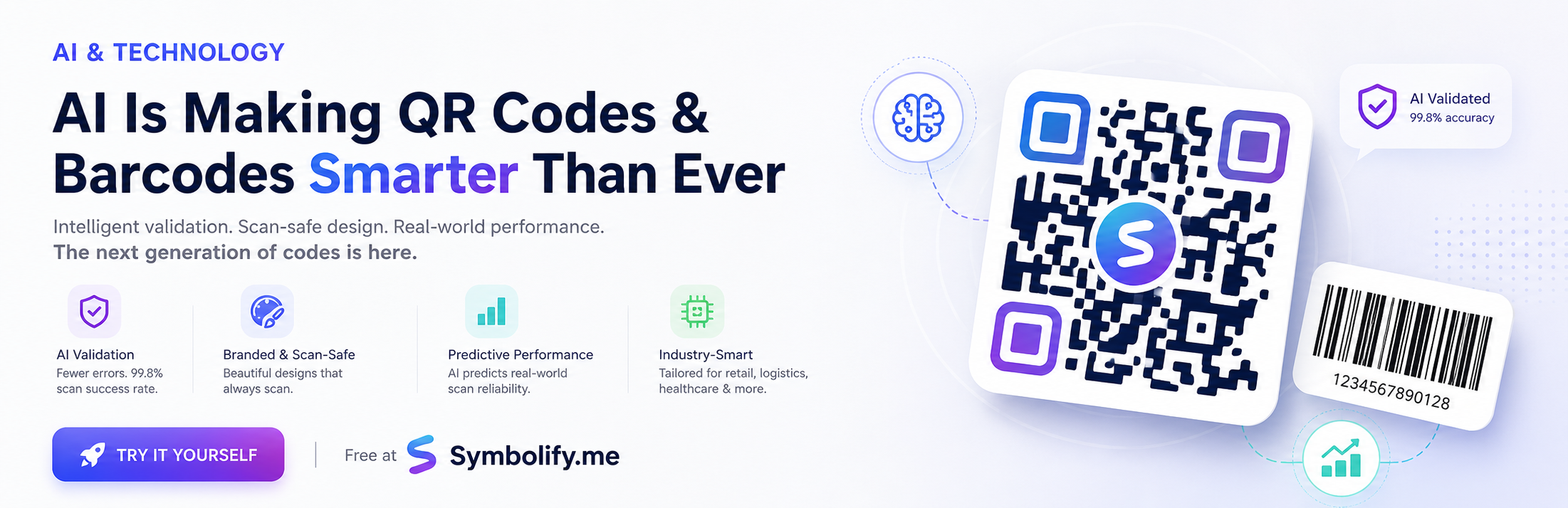
How AI Is Making QR Codes & Barcodes Smarter Than Ever
Artificial intelligence is quietly transforming the humble barcode — from a simple data container into an intelligent, self-validating, beautifully designed bridge between the physical and digital world.
For decades, QR codes and barcodes have worked the same way: a pattern of lines or squares encodes data, a scanner reads it, done. The technology was reliable, but dumb. Today, artificial intelligence is injecting intelligence into every step of that process — from creation to scanning to analysis.
1. Dramatically Better Accuracy
One of the biggest practical problems with generated codes has always been human error on the input side. A mistyped URL, a wrong digit in a product ID, a URL that's technically valid but points to a dead page — these mistakes are invisible at creation time and catastrophic at scan time.
AI-powered generators now run real-time validation before a single pixel is rendered. Natural language processing checks URLs for common typos — transposed letters, missing slashes, wrong TLD. Barcode logic engines verify check digits across all major standards — EAN-13, UPC-A, Code 128 — automatically, without the user needing to understand the underlying math.
💡 Why this matters:
A single incorrect barcode on a retail shelf means a product that won't scan at checkout. In logistics, one bad Code 128 label can derail an entire shipment. AI catches these errors before they're ever printed.
Scan success rate with AI-validated codes
Faster error detection vs manual review
Check-digit errors when AI validates output
2. Smarter, Scan-Safe Design
Traditional QR codes are ugly by necessity — or so the thinking went. Pure black modules on a white background were the only "safe" option because any customisation risked breaking scannability. AI has completely upended this assumption.
Modern AI models can evaluate thousands of design permutations in milliseconds, testing each combination of colours, dot shapes, logo placements, and corner radii against simulated scanning conditions. The result is a system that can confidently offer branded, visually distinctive QR codes while guaranteeing they'll scan reliably in the real world.
- Contrast analysis
AI flags colour combinations that look great on screen but fail in low-light or high-glare environments before you download.
- Quiet zone enforcement
Automatically ensures the required clear border around codes is maintained, even when users resize or crop exports.
- Module density optimisation
Long data strings create dense, hard-to-scan patterns. AI recommends URL shortening or encoding changes to keep patterns clean.
- Logo embedding safety
AI calculates safe logo coverage percentages against error correction levels, so your brand mark does not break the code.
The best QR code isn't the one that looks the most impressive — it's the one that gets scanned every single time, from any angle, in any lighting condition.
— UX principle behind AI-assisted code design
3. Industry-Specific Intelligence
Different industries use codes in completely different ways, and a single generic generator can't serve all of them equally well. AI enables context-aware generation — where the tool understands the environment the code will live in and adapts accordingly.
Retail & e-commerce
AI validates EAN and UPC codes against GS1 standards, checking digit structure and range to ensure compatibility with global POS systems — not just local scanners.
Logistics & warehousing
For Code 128 and ITF-14, AI checks density and quiet zone requirements for industrial laser scanners — which have far stricter tolerances than smartphone cameras.
Healthcare & pharmaceuticals
Pharmacode generation includes range validation, flagging values that fall outside typical pharmaceutical encoding windows before labels are printed at scale.
Marketing & events
AI predicts scan rates based on print size, viewing distance, and expected ambient lighting — giving marketers confidence before spending on large-format print runs.
4. Predictive Performance & Analytics
Beyond generation, AI is transforming how we understand code performance after deployment. Machine learning models trained on millions of scan events can now predict how a given code will perform based on its visual properties, print medium, and deployment context — before it's ever used in the wild.
This means a brand manager can know, with reasonable confidence, that their QR code on a matte-finish business card will scan reliably from 30cm away, while the same code on a glossy outdoor banner may need its error correction level increased. These insights used to require expensive field testing. AI makes them available at generation time.
💡 Data insight:
Research consistently shows that branded QR codes — those with custom colours and embedded logos — achieve up to 40% higher scan rates than plain black-and-white equivalents, largely due to increased user trust and visibility.
5. What's Coming Next
The current generation of AI tools has already transformed code generation from a mechanical process into an intelligent one. But the next wave of capabilities — currently in development across the industry — will go further still.
Natural language generation is emerging as a major interface shift. Instead of filling form fields, users will simply describe what they need: "a branded QR code for my restaurant menu, warm earthy colours, with a fork icon" — and the AI handles the rest. Layout intelligence will allow generators to suggest optimal code placement within uploaded design files. And adaptive regeneration will alert users when their static codes point to changed or broken URLs — turning a one-time creation tool into an ongoing quality assurance system.
The barcode has been a workhorse of commerce and logistics for over 50 years. It didn't need to be smart to be useful. But with AI, it's becoming something far more powerful — a reliable, designed, context-aware data layer woven into everything from product packaging to physical marketing to healthcare infrastructure.
Experience AI-powered QR & Barcode generation free at Symbolify.me
Everything described in this article — smart validation, branded design, multi-format barcode support — is available free, with no account required, at Symbolify.me.